
Learn MTA's position on pending legislation related to public education and worker rights, and take action to protect our schools, workplaces, and communities
Published: June 2026
Updated on July 31, 2026
On July 30, the state Senate appointed members to its conference committee for H.4361/S.3109. This follows the state House of Representatives, which assigned its members to the committee on July 16. The conference committee is responsible for resolving differences between the House and Senate versions of this bill. Under new legislative rules, lawmakers have until January 5, 2027, to complete conference committee negotiations, vote on the bill and send it to the governor.
Because the legislative session does not end until Jan. 5, 2027 – and because there is no requirement that the conference committee reaches an agreement – the MTA is urging its members to contact their legislators now and let them know how important it is that the fair fix for RetirementPlus be sent to the governor as soon as possible.
A fair compromise that teachers can afford is within reach – but only if legislators hear directly from educators and treat this issue with the urgency it deserves. Your advocacy is essential to ensuring the final bill delivers a fair and affordable fix.
The most effective way to move this bill to the governor’s desk is for legislators to hear from educators like you. Please send a message to your legislators today. It is important that your legislators continue to hear from you.
Recent Events
On June 4, the state Senate passed a redrafted version of H.4361, which the House passed last July. This is an important step forward, and we thank the Senate for passing the bill.
The amended bill, S.3109, continues to allow Massachusetts teachers who were part of the Massachusetts Teachers' Retirement System or the Boston Retirement System before July 1, 2001, to have a new opportunity to join RetirementPlus, but it makes a few changes. The changes include increasing the buy-back cost to join RetirementPlus.
Under the original bill, an eligible teacher must make up the difference between the current RetirementPlus contribution rate of 11% and their past rate. This bill, S.3109, still requires that the teacher make up the contribution difference, but also adds annual compounded “actuarial-assumed interest at the rate in effect from year to year,” which ranges from 8.5% in 2001 to the current 7%. The 7% is the current rate of return that the pension system has set as its assumed rate of return for its investment.
The addition of this compounded interest rate is a concern as it will increase significantly the cost of buying back, which might make it unaffordable for too many members.
Unfortunately, we do not yet have the tools needed to calculate individual costs. We have been told, however, that under the Senate bill, teachers hired between July 1, 1996, and June 30, 2001, who are contributing 9% on their entire salary plus an additional 2% on their earnings over $30,000, would be required to pay about $41,000.
Teachers hired before July 1, 1996, who contribute 8% on their entire salary plus an additional 2% on their earnings over $30,000, would pay about $41,000 plus 1% of their annual salary (compounded annually) for each year worked after July 1, 2001. Varying interest rates and salaries require individual calculations for each eligible teacher.
We are hopeful that the state will soon create a tool that allows eligible teachers to estimate their total cost, and we will update you as soon as they do.
It is important to keep in mind that there will be additional opportunities to amend this bill (and hopefully improve it) as it moves forward. The new bill has been sent to the House, where state representatives will either agree to the amended bill, further amend it or insist on the House version and establish a conference committee to work out the differences between the two chambers.
Once an agreement is reached, the final version of the bill will be voted on in both branches and sent to the governor. The timing of the bill moving forward is unclear, so please keep an eye out for important updates from the MTA. The addition of this compounded interest rate is a concern as it will significantly increase the cost of buying back, which might make it unaffordable for too many members.
Cost Estimates
The estimated cost of the House version of the bill, H.4361, and the Senate’s version of the bill, S.3109, for teachers hired on or after July 1, 1996.
- H.4361 Example: (9% + 2%) with 25 years of service. Total cost is (25 x $600) = estimated total cost of $15,000.
- S.3109 Example: (9% + 2%) with 25 years of service. Total cost is (25 x $600) = $15,000. When compounded with actuarial interest annually = estimated total cost of $41,200.
For teachers hired before July 1, 1996, the calculation is more complicated. Those teachers generally contribute 8% on their entire salary plus an additional 2% on their earnings over $30,000, the annual difference for these teachers is usually $600, plus 1% of their salary.
- H.4361 Example: (8% + 2%) cost is (25 x $600) = $15,000
If that teacher had earnings of $1,450,000 over the last 25 years (average annual salary of $58,000,) their 1% buyback would be $14,500. Total $15,000 + $14,500 = estimated total cost of $29,500.
- S.3109 Example: (8% + 2%) (25 x $600) = $15,000, when compounded with actuarial interest annually = $41,200.
Unfortunately, we do not have the data needed to give a total cost on the compounded 1% of salary. We do know it would be calculated by adding the estimated cost of $41,200 (for 9%+2% teachers) to 1% of a teacher’s annual salary, compounded annually using actuarial interest. Using the example above, the total owed would be $41,200 + $14,500 (in compounded interest) = an estimated total cost of $55,700 + X (X = compounded interest on 1% of salary).
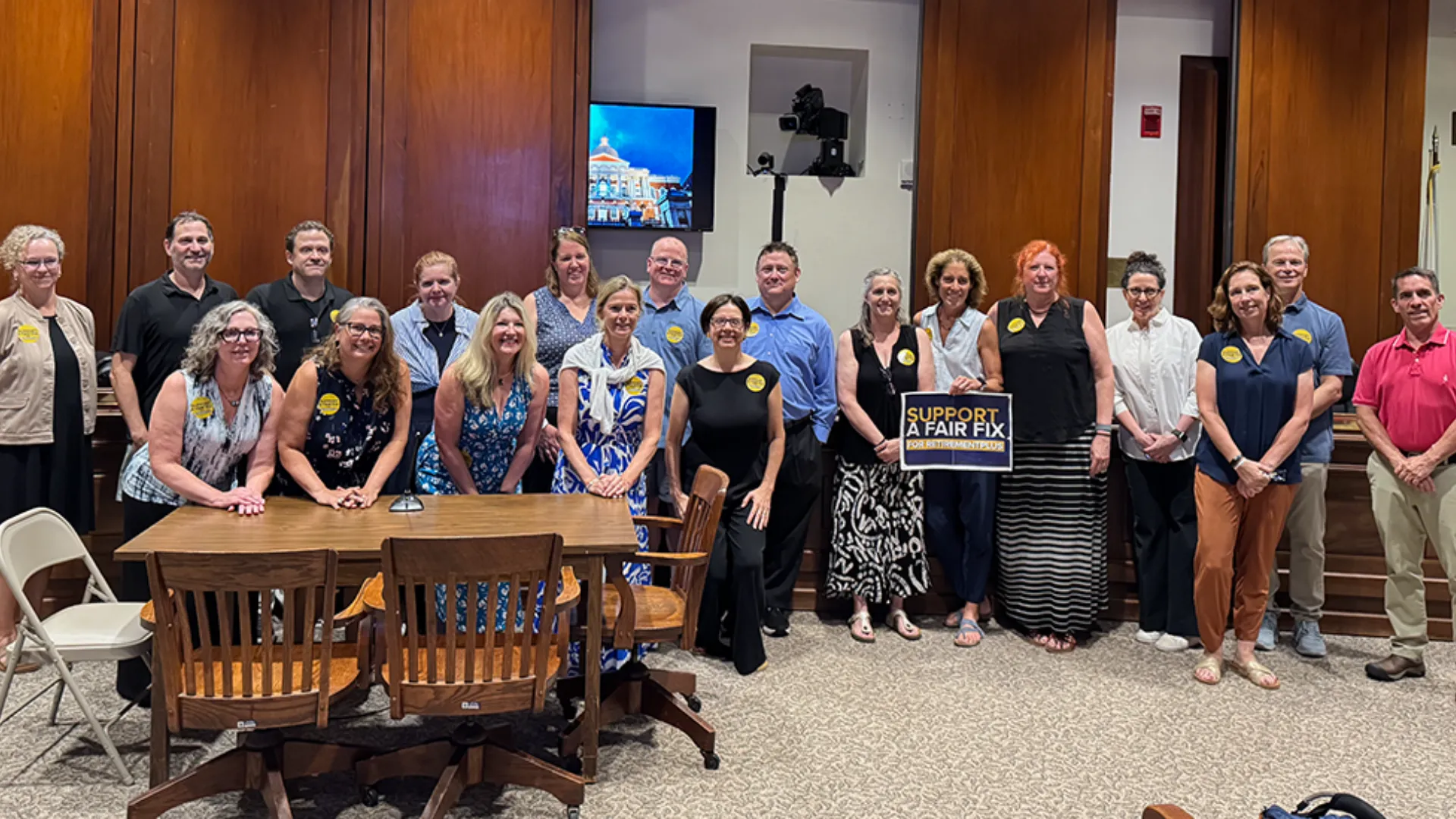
We thank all MTA members who helped move this issue forward. Without your grassroots advocacy, this progress would not have been possible. We ask that you continue working on this issue and urge your state legislators to support a Fair Fix for RetirementPlus.
Background
In 2001, when RetirementPlus was first introduced, many teachers encountered a confusing enrollment process. Some never received an enrollment form while others were led to believe they were automatically enrolled in Retirement Plus, only later learning that they were not. The MTA has worked to rectify these issues administratively, however, an August 2023 ruling by the Division of Administrative Law Appeals has made it clear that legislation is needed to fix this problem.
In the ruling, DALA stated “that a 2001 teacher cannot join the § 5(4) benefits program [RetirementPlus] after missing the mid-2001 deadline, even in sympathy-provoking cases, and even if the teacher received no notice about the § 5(4) program” from their retirement system. This unfortunate but clear statement from DALA makes passing legislation the only way to rectify this unfair process.
Bills in the Legislature
-
Support
H.4361 (formerly H.2932) An Act Relative to Benefits for Teachers malegislature.gov
Introduced on January 2025
Lead Sponsors: Rep. Alice Peisch (D-Wellesley) | Rep. Rob Consalvo (D-Boston) Allows teachers hired before July 1, 2001, who did not provide a written election to participate in RetirementPlus, to have a second opportunity to do so.
-
Support
S.1884 An Act Relative to Teacher Retirement Election malegislature.gov
Introduced on January 2025
Lead Sponsors: Sen. Liz Miranda (D-Boston) Allows teachers hired before July 1, 2001, who did not provide a written election to participate in RetirementPlus, to have a second opportunity to do so.
The Fair Share Amendment at Work
Learn how revenues from the Fair Share Amendment are providing funding for free lunch for students, financial aid for public college students, transportation and more.
Education Funding News
Take action to win legislative and budgetary fixes to the growing fiscal crisis impacting our public schools and colleges and get the latest financial numbers for education funding.
